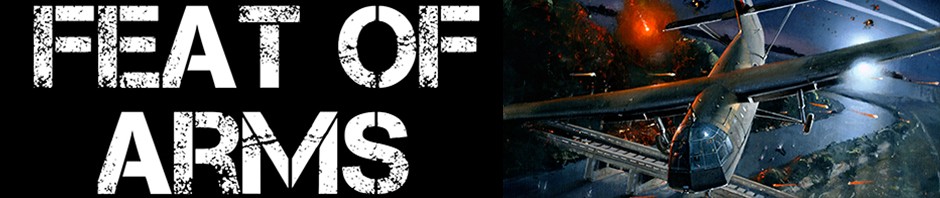
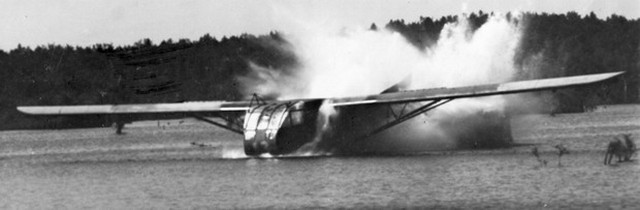
Miles off course, Glider 58 landed in the sea. After hours of swimming, did some of its men join a beach assault under shell-fire?
Manifest
Glider carrying: Part of Battalion HQ, 1st Battalion of the Border Regiment, 1st Air Landing Brigade
Troops’ objective: Outskirts of Syracuse.
2 i/c.
Batman.
I.O.
Sig. Sgt. 18 set.
1 man Def. Sec.
2 sigs 18 set.
2 sigs 68 set.
RAMC Sgt.
2 men “I” Sec.
1 handcart
4 folding bicycles?
Maj. Tommy Haddon, 2 i/c
Lieut. Ronald C Hope-Jones, Intelligence Officer (IO)
Sjt. J Maloney
Sjt. N B Marsh, RAMC
L/Cpl. T Blaycock
L/Cpl. C R Thirlwell, Intelligence Section
L/Cpl. I A S Thomson, Royal Signals
Sigmn. V J Boaler, Royal Signals
Pte. T Chapman
Pte. L Ingham
Pte. H Nolan
Pte. J L Sheldon
Intelligence Officer’s equipment:
1 x .38 revolver with 50 rounds of ammunition
1 x knife
4 x 77 smoke / phosphorous grenades
1 x Verey pistol with 12 cartridges
1 x mapcase
1 x binoculars
1 x compass
1 x spare Bren magazine
plus other personal equipment
Total 60 lbs
Glider 58 carried roughly half of Battalion HQ. The other half, with a similar composition, was carried in Glider 57. The duplication allowed for some backup, but the plan was to have both a rear and an advance HQ. Since Glider 57 also came down in the sea, there was no functioning Battalion HQ at all. For more information see the Story of Glider 57.
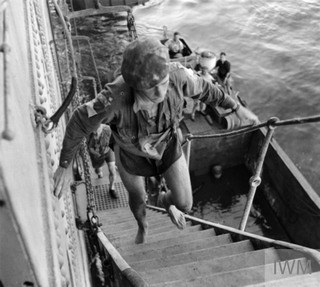
Right:
Lt Hope-Jones climbs aboard HMT Winchester Castle. Behind him can be seen the landing craft (an LCM?) that picked him up.
He wears a deflated lifebelt across his chest, with the inflation tube tucked into one of its straps.
The white squares on his upper arms are night recognition patches which indicate that he is an officer in Battalion HQ.
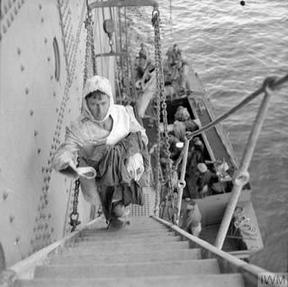
Left:
L/Cpl Blaycock climbs aboard HMT Winchester Castle. Behind him can be seen the LCA (Landing Craft Assault) that picked him up. He seems to be wearing naval clothing (including a flash hood) and to be carrying his uniform. Behind him on the stern of the LCA is a ‘folbot’ two-man collapsible canoe.
These folding boats were stationed in the night off the various invasion sectors to guide the landing craft to their beaches. They flashed the sector letter in Morse code seawards, eg G for George, J for Jig.
Glider Pilots’ Report
1st Pilot: Lieut. Michael B Connell
2nd Pilot: Sjt. Herbert D G Hill
Glider: CG-4A Waco 58
Glider allotted Landing Zone: LZ 2.
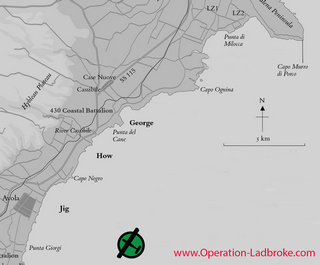
Statement by Passenger – Flight bumpy, but uneventful until reaching SICILIAN Coast. At 2230 hrs and at approx 1500 ft, when tug a/c appeared to sheer off to East, glider was released about 5 miles off shore. Glider landed in sea about 3 miles S.E. of AVOLA. Both pilots missing, believed drowned.
Tug Pilot’s Report
Tug: C-47, serial 41-18457, 7 Troop Carrier Squadron, 62 Troop Carrier Group, 51 Troop Carrier Wing USAAF.
Takeoff: Between 19:05 and 19:22, from Airstrip C, El Djem No. 2, Tunisia. Priority 2.
Tugs returned: Between 00:38 and 04:15, except one which landed at Sfax.
Pilot: 1st Lt Henry, Cecil P.
Individual debriefing reports by the tug pilots of 62 TCG do not seem to have survived, or else are lurking in an archive somewhere as yet undiscovered.
Hope-Jones’ Story
Lt Hope-Jones left two accounts of the ditching of Waco 58. This is an excerpt from one of them:
“The approach flight over the sea at sunset was thoroughly enjoyable though rather bumpy. By the time we reached the Sicilian coast it was dark, and our first sight of land was a dark strip of coast beyond moonlit waves. From a purely aesthetic point of view it was absolutely beautiful, but as we came nearer to the shore flak began to come up, and after that I didn’t pay much attention to the aesthetic side of it. Our tug pilot had been blown off his course and didn’t know where he was. We made a crash-landing in the sea, and the water poured in as soon as we hit. It was round our waists by the time we got the emergency doors off, and rising rapidly. I remember cursing myself for taking a commission as we waited for the men to scramble out, with the water now round our necks and rising rapidly. At last Tommy Haddon and I got out on either side, but all my equipment, 60 lb. in weight, got caught round my feet, and as the glider was drifting seaward in a strong wind, I had a most unpleasant two minutes before I could get back to it and pull myself on to the wings. We stayed on the glider for about half an hour, but by then it was very low in the water and it was obvious that with a load of 13 men on it it was bound to sink pretty soon. The only possible course was for the swimmers to try and make shore, in the hope that with a lightened load the glider would support the non-swimmers until they could be picked up in the morning: so Tommy and I and a signaller [Thomson] removed our boots and shorts and started to swim ; it was then about 11.30 at night. Another party followed us a few minutes later, and though we don’t know what happened to this second party, the five non-swimmers on the glider were picked up some hours later, just as it sank.
“After an hour’s swimming, the land seemed further off than when we started. The sea was rather rough, there was a strong wind from the shore, and the general outlook pretty depressing. We swam on and could hear and see the bombing of Syracuse by the R.A.F. between 0215 and 0245, a long way to the N.E.
“Suddenly the shore was quite close. We’d become separated from our signaller by then, and could hear an Italian post on the cliff we were making for. We expected them to open up at any minute, but they didn’t, and after four hour’s swimming we reached land, very full of sea and completely exhausted. We went straight to sleep on a broad ledge of rock under the cliff. When we woke up an hour or two later, there was a beach landing in full swing a few hundred yards to our right as we looked out to sea. We attracted the attention of one of the Assault Landing Craft, which came in close to us, and then we swam out to it. It was full of Engineers and we made a fine landing with them under shell-fire, but as we had nothing but our shirts and berets on, and no weapons, we didn’t feel we should be much use, and went back with the A.L.C. to the parent ship in the bay.”
This is a classic British account, full of wry, self-deprecating humour. In it, fear of imminent drowning is not terrifying but ‘unpleasant’ or ‘pretty depressing’. Hope-Jones, who was an extremely intelligent and competent Battalion Intelligence Officer, here paints himself as slightly bumbling, jolted out of admiring the moonlight by the prospect of death by anti-aircraft fire, or regretting being an officer as he heroically stays in the fast-sinking glider to let the enlisted men escape first. This story of the ditching culminates in a climactic comic scene as he and Major Tommy Haddon assault a beach under shell-fire in their underpants or, possibly, no underpants. Underpants are explicitly excluded from the list of what they were wearing, but that raises the question why, as they were surely no hindrance to swimming. In any case, it was a ‘fine’ landing, the word ‘fine’ being a comic counterpoint to the undignified and farcical situation.
However the scene is not likely to be accurate, as landing craft were not supposed to jeopardise their crucial in-bound missions to rescue men in the water, even less so if the men were already safely on land. The humour is also a give-away, as it is clear that events are being selected, exaggerated and milked for droll effect. In reality, of course, there is nothing funny about drowning, and soldiers dread artillery barrages, especially when out in the open.
The story behind this account explains the light-hearted tone and the emphasis on entertainment. It was based on a letter Hope-Jones wrote to his mother, for whose benefit he presumably wanted to keep the tone insouciant and light. She in turn cleaned it up slightly to avoid giving offence to the American tug pilots, and then submitted it to her son’s prep school, who published it in the school magazine.
Hope-Jones also kept a personal diary, which differs from the letter in several ways. For one thing, there are no jokes in the diary account of the ditching. The details also differ. For example, in the diary he wrote this about being dropped in the sea, which impugns the courage of the American tug pilots, a charge absent from the letter:
“I couldn’t recognize the coast, and we made a couple of circles before our C47 sheered out to sea away from the flak and we cast off. There was never a hope of reaching land.”
Of swimming ashore he wrote in the diary:
“After the moon went down, we couldn’t see the shore, but when I trod water and lifted my head as far as I could, I could just see a single light, and we swam for that. We made it eventually, landing in a choppy sea on a rocky coast, and though shivering uncontrollably I went straight to sleep. When we woke up it was broad daylight and we found we were just to the side of an assault landing beach. An LCA was diverted to pick us up, and it eventually took us back to its parent ship.”
The diary thus doesn’t mention joining a beach assault dressed only in shirt and beret, armed to the teeth with nothing. The word ‘eventually’ does not specify where the LCA went after picking him up, but all in all it’s clear that the tale is a tall one, and it probably went down well after dinner in the officers’ mess.
The letter also does not mention casualties as such. What it does say is this:
“Tommy and I and a signaller [Thomson] removed our boots and shorts and started to swim … Another party followed us a few minutes later, and though we don’t know what happened to this second party, the five non-swimmers on the glider were picked up some hours later.”
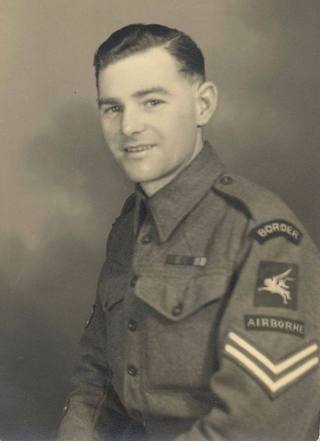
The reality was that the second swimming party vanished without a trace, certainly drowned. It consisted of the glider pilots Connell and Hill, and the medic Marsh, who was ironically apparently the strongest swimmer in the battalion. As IO, Hope-Jones was responsible for gathering and reporting information about missing men, in an attempt to confirm what happened to them. He knew that these three men would be formally classified as ‘missing’, which is somehow a more dreadful label than simply not knowing. Maloney also drowned, shortly after getting out of the glider. He was a non-swimmer. Sheldon attempted to help him, but exhausted himself trying and had to give up. The remaining eight men, including L/Cpl Thirlwell of Hope-Jones’ Intelligence Section, were rescued.
Hope-Jones and Haddon were taken to the troopship HMT Winchester Castle. Here they briefly rested, had a luxury breakfast and were equipped with shoes and clothing. They then went ashore to Avola and then on to the Ponte Grande bridge, where they found 1 Air Landing Brigade HQ. Hope-Jones spent the rest of the day and the next two days scouring the LZs and the Maddalena Peninsula for wounded men, sometimes running, sometimes on a bicycle or in an ambulance, or even in a tank transporter in the absence of ambulances. On 13 July the airborne survivors boarded LCI(L)s which took them back to Sousse in Tunisia, where Hope-Jones continued the huge task of reporting on the Battalion’s killed, wounded and missing.
.
Accounts by Nolan and Thirlwell can be found on pages 153-155 of Mike Peters’ “Glider Pilots in Sicily”, which can be bought from the publishers [here].
Extensive excerpts from Hope-Jones’s diary can be found in Stuart Eastwood’s “When Dragons Flew”, available from the Cumbria’s Museum of Military Life [here].

L/Cpl. C R Thirlwell was my Dad. I knew a bit about the glider coming down in the sea during the Sicily operation. It was about the only thing he mentioned regarding the war. A couple of years ago I bought Mike Peters’ book without knowing of my Dad’s account in it – his initials wrongly stated as G R – so I was quite emotional when I found it. I’d dearly like to find his original letter, and did contact Mike Peters but he couldn’t remember who had it.
Not being a swimmer Dad stayed with the part submerged glider until picked up,.
Sadly, after surviving Sicily & Arnhem Dad died in a road accident in 1960, scarcely a year after leaving the army.
Thanks Ian