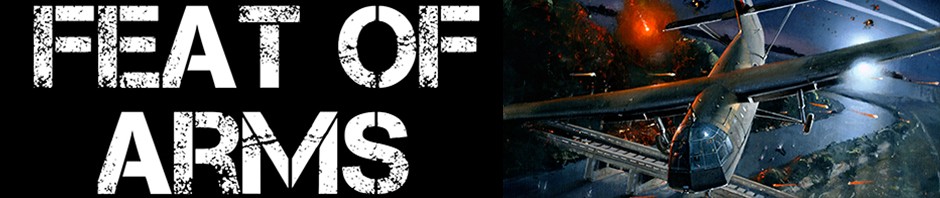
Flying low and slow into the fire of Italian guns near its LZ, Horsa 132 was hit multiple times, exploded and burned.
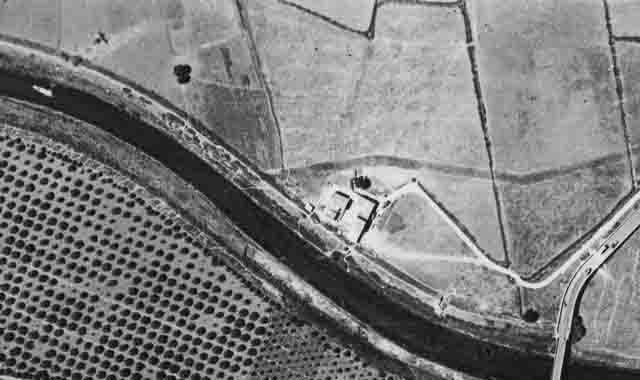
Glider: Horsa 132.
Glider carrying: 17 Platoon of ‘C’ Company and half of company HQ, 2nd Battalion of the South Staffordshire Regiment
Troops’ objective: From the Staffords war diary:
‘C’ COY commanded by Maj E.G. Ballinger were carried in 4 Horsa gliders [132-5] – they were to land immediately SW of Ponte Grande ([codename] Waterloo) and capture the bridge to enable 17 Inf Bde to pass through to Syracuse next day.
Manifest
From the loading tables:
Coy Comd
Batman
1 Offr R.E.
1 Signaller.
Nursing Orderly.
C.S.M.
Clerk (Sig Pl).
17 Pl:
Pl Comd 17 Pl
22 O.Rs. No. 17 Pl. 6000 lbs total weight 30 men
No. 18 set. 50 lbs
Pannier of ammo. 35 lbs
PIAT & bombs. 50 lbs
Explosives. 60 lbs
Bicycle. 30 lbs
Boat. 30 lbs
Some special equipment was specified in the Staffords Operation Order:
25ft of rabbit wire per Pl.
One 24ft Bangalore torpedo per pl.
One pole charge per pl.
One flame thrower.
Four grappling irons.
Known passengers:
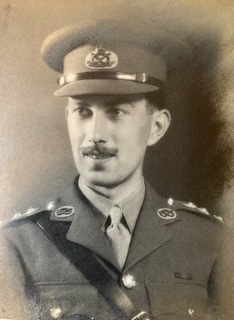
Maj E G Ballinger, CO ‘C’ Coy
Lt H D Scott, CO 17 Pltn
Colour Sgt (A/CSM) L L Knight
Sgt G Shaw
Cpl M W Byers, attached from
9 Field Coy, Royal Engineers
Cpl B P Murphy
Pvt W T Foster
Pvt J Horton
Pvt H W Lampon
Major Ballinger was only 26 years old, having joined the South Staffords at 18. Both his father and his grandfather served with the Regiment. His father died three days after his son, without learning of his death in Sicily.
Tug Pilot’s Report
Tug: Halifax callsign VV, number DK131, 295 Squadron, 38 Wing RAF.
Takeoff: 20:02, 9 July 1943, from Airstrip E, Goubrine 1, Tunisia. Priority 1.
Tugs returned: 00:20, 10 July 1943.
Pilot: F/O Bewick.
Intercomm. u/s shortly after take-off. Landfall made 3-4 miles off Capo Passero 4000 ft. Release made in correct area but closer in shore than briefed.
Glider Pilots
Glider allotted Landing Zone: LZ 3 South.
First Glider Pilot: Capt J N C Denholm.
Second Glider Pilot: Sgt Knott
Examination of the wreckage by an American glider pilot:
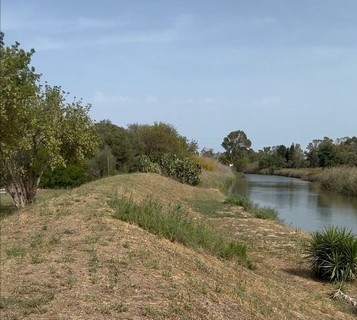
This glider struck a high dike on the north side of a canal and was completely demolished. It apparently exploded on contact and all occupants were killed. Two wheels and one wing panel on south side of dike in the canal; the empennage on the north side of the dike; the rest of the glider is entirely burned.
Capt Denholm was one of the pilots who had flown Horsas from England to Tunisia as part of Operation Turkey Buzzard / Beggar. Lt Col Chatterton, CO of the Glider Pilot Regiment, was briefing his pilots for Sicily shortly before Operation Ladbroke when Denholm arrived. Chatterton recalled him appearing in the doorway with his long fair hair beneath a beret set at a jaunty angle, drawling with British nonchalance and dry humour: “I say, I’ve come to see a man about an operation”. This image stayed with Chatterton as he inspected the remains of Horsa 132 after the battle. He found a “terrible” sight, a “macabre and tragic” pile of bodies “blown forwards as if down a funnel, but of the pilot there was no sign” (‘The Wings of Pegasus, 1962, p94).
Infantry Reports
Contemporary reports estimate Horsa 132’s crash site as 200, 300 or 400 yards from the bridge. In fact the distance from the crash site to the site of the pillbox in the middle of the bridge was 445 yards.
There was also a tobruk (a concrete machine gun emplacement) some 120 yards closer to the crash site.
South Staffords war diary:
No.17 Pl commanded by Lt Scott with Maj Ballinger and half Coy H.Q. crashed about 200 yds upstream of the Bridge and burst into flames; there were only three survivors, Lt Scott and 2 O.Rs. all of which were seriously injured, the remainder including Maj Ballinger and A/CSM Knight were killed.
9 Field Coy, Royal Engineers war diary:
This Horsa made a very rough landing about 300 yards from Waterloo, and in direct view of the pillbox on the bridge. The tail broke off and it is thought that the ammunition and explosive was hit by S.A.A [small arms ammunition] and went up as the bodies were thrown a considerable distance from the wreckage and badly burnt. Cpl. Byers body was found and buried on the canal bank.
Italian Report
The following account was given in Rome on 20 July 1943 as part of an Italian inquest into the collapse of the Augusta-Syracuse Fortified Zone. It was made by Filiberto Francioni, an officer in Battery AS 365, which was codenamed Gnat by the British. Gnat comprised six 76/40 dual purpose (AA and anti-ship) guns. It was manned by Fascist artillery militia of the 9th Legion. Gnat was also equipped with heavy machine guns and a searchlight. It was situated on top of low cliffs in the middle of the west shore of Syracuse’s Grand Harbour, some 1.34 km from the Ponte Grande and LZ 3.
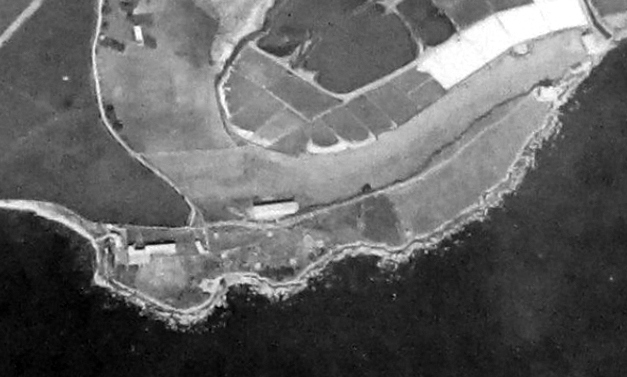
At 21:40 [9 July 1943] Group South AA HQ ordered an air raid alert for a formation of enemy aircraft headed for Syracuse [this was the planes of Operation Ladbroke]. At 21:45 our AA batteries went into action. My battery 365 (at Lido Armenia), situated in the centre of the bay, fired independent barrages against aircraft coming from the west headed east […] Between the second and third barrage I saw a plane coming from west, course: east, north, west (three quarters of circle and centre battery) [sic], height about 400m, distance about 600m.
Francioni’s description of the track of this aircraft is garbled, but could be interpreted to mean that the plane came from inland (the west), then turned north above the battery, then turned west towards the bridge and LZ 3. This was Horsa 132. At this point the Italian gunners were unaware that they were dealing with gliders, as opposed to powered aircraft.
I opened fire with a Breda 13.2mm [heavy] machine gun, followed immediately by fire from a second machine gun. The plane was hit squarely and kept under fire by intense bursts. I was surprised by its low speed – I had time to fire five full magazines at it. At 22:00, a second plane with the same course, distance and height as the first was targeted by the machine guns, helped by the searchlight, which held the plane in its beam until it fell.
This second plane was Horsa 133, whose pilot S/Sgt Dennis Galpin described how an Italian searchlight following him lit up the bridge for him, crucially enabling him to land dead centre in LZ 3, his objective. Gnat’s searchlight thus helped the British more than the Italians. Later examination of Horsa 133 showed it had “30 or more flak holes”. Francioni continued:
At 22:10, the CO of my battery ordered an armed patrol of six men to execute a reconnaissance in the area where the two aircraft seemed to fall. I took command of the patrol. At 22:45 we reached the place where the first aircraft fell (by the edge of the River Anapo, about 1200m from the river mouth, on the Syracuse side). There I found among others a Carabiniere brigadier and soldiers of coastal units. The plane was missing its entire front part. Scattered on the ground were some 40 men in khaki uniform, a good half of them wounded. I was surprised by their number.
Francioni’s description of the wreckage and the crash site make it certain that he is describing Horsa 132, although he still didn’t realise that the planes he had fired on were gliders which were coming down deliberately, as opposed to having been shot down by his battery. Francioni continued:
Curious, I examined one of the men close up. On his belt he had five magazines for a 9mm submachine gun [a Sten gun]. On the ground there were some [grenades]. I opened a haversack: it contained many tins of food and small American and English flags, binoculars, also bombs about 45cm long, calibre about 60mm, with fins, some in cardboard or fibre tubes [for a mortar]. Evidently the troops belonged to an invasion unit. I apprised the brigadier of this, and told him to sweep the area for possibly uninjured members of the crew of the shot-down aircraft. I returned with my patrol to the battery at the double. I reported to my CO who immediately put the battery in a state of close-quarters defence, ordering me to deploy men and weapons to the positions.
Another Italian account mentions that the British troops of Horsa 132 had a bugle or horn. These were particularly useful to airborne troops, which tended to be dispersed on landing, especially at night. Horns helped them rally to fight as a cohesive units. Loading lists for 1st Border gliders show that each glider that carried a company CO also carried a bugler. A horn on the Ponte Grande was heard repeatedly sounding “Waterloo taken” in Morse code, to draw scattered glider troops to reinforce the bridge.
The bodies of those killed in Horsa 132 were buried after the battle at the crash site. They were later reburied in the CWGC war cemetery in Syracuse.
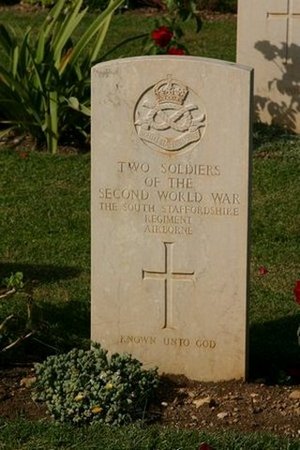
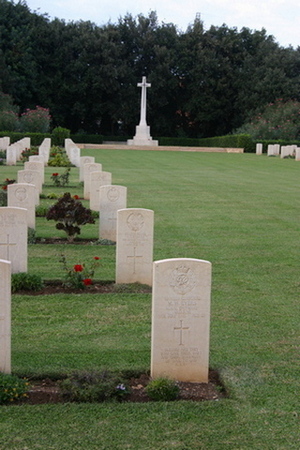
Two unknown Staffords Corporal Byers' grave
